

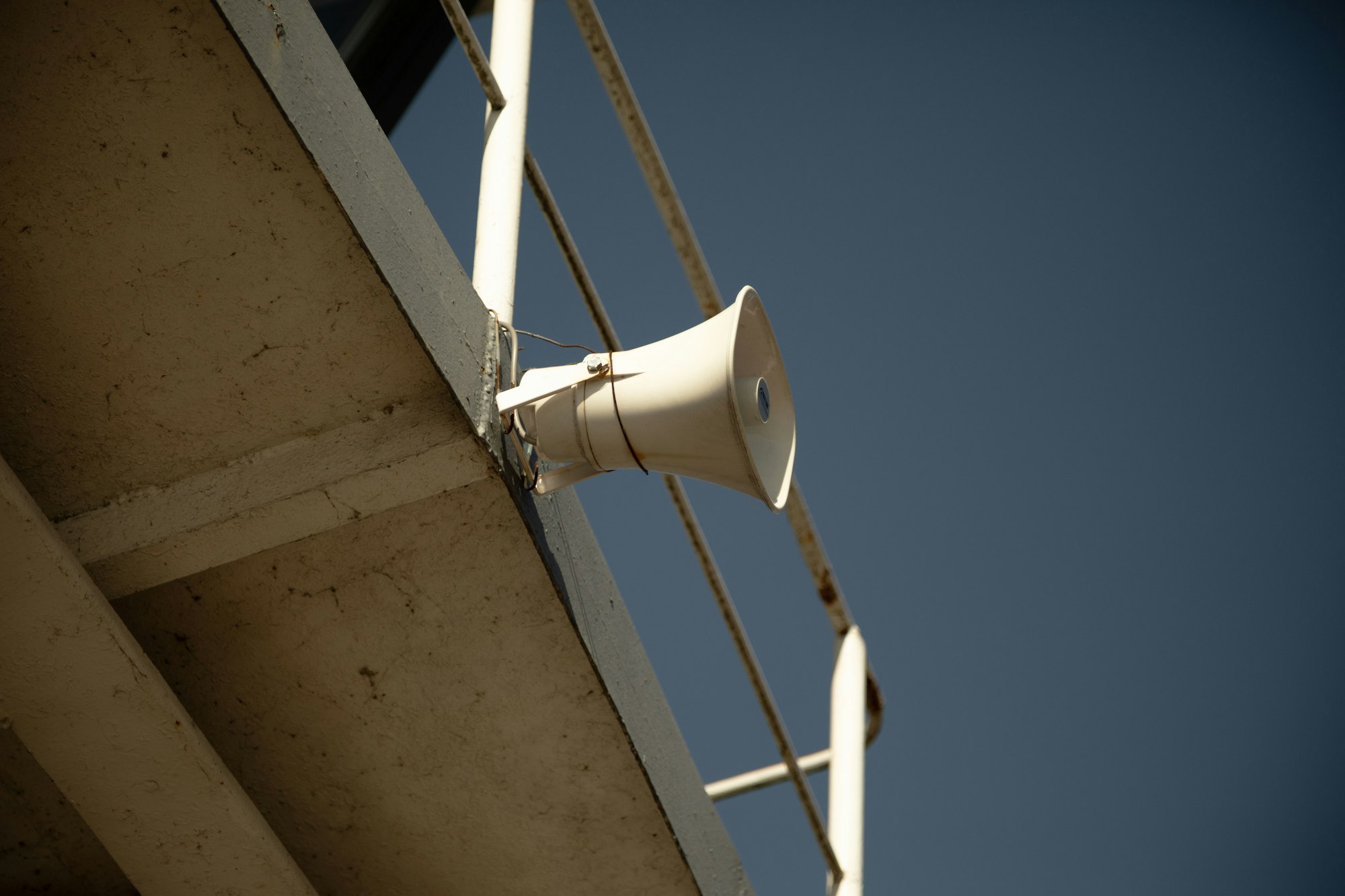
Rail calls it PA - on metro networks, long line public address, LLPA. Buildings call it PAVA - public address and voice alarm. Oil and gas facilities call it PAGA - public address and general alarm. Underneath the three names is one safety function: a voice message that people understand the first time, in the environment they are actually standing in, on the day something goes wrong.
The engineering discipline behind that function is the same across all three industries. The standards are not. This article maps them, and untangles the three quantities that get confused along the way: how loud a system is, how far above the noise it sits, and whether anyone can understand it.
Loud is not understood
Sound pressure level (SPL) is the quantity everyone knows - decibels at the listener. Audibility rules are written in SPL terms: the Australian emergency warning standard requires warning signals at least 10 decibels above the ambient noise, and never below 65 or above 105 dB(A). Rules like that guarantee you can hear that a message is playing. They say nothing about whether you can understand it.
The distinction matters because the failure mode of a badly designed voice system is not silence - it is loud, boomy, unintelligible announcements. In a reverberant space, turning the volume up past a point makes intelligibility worse, not better. And the noise the message competes with is not a constant. Stand on a platform under a road bridge as a train arrives and the ambient level transforms in seconds. On an offshore facility, a gas turbine changing operating regime changes the noise context for every space around it. A system set up for the quiet case fails in the loud one.
Signal-to-noise ratio (SNR) is the next layer: how far the message sits above the ambient noise. The familiar design rule of 10 decibels above ambient is a starting point, not a requirement - in reverberant or acoustically hard spaces it is not enough, and intelligibility gains saturate once speech sits around 15 decibels above the noise. The correct logic runs the other way around: the intelligibility requirement determines the SNR a space needs, not the reverse. The noise side of the ratio can sometimes be engineered too - barriers, enclosures, absorption - but that is generally the territory of environmental and building acousticians. The system side, from source to loudspeaker, is where this article lives.
What intelligibility actually measures
Speech intelligibility is measured as the Speech Transmission Index (STI): a number from 0 to 1 expressing how much of the information in speech survives the path from the system's input to a listener's ear - through the electronics, the loudspeakers, the room and the noise. The governing measurement standard is IEC 60268-16, currently edition 5.0 (2020).
In practice the measurement is almost always STIPA - a condensed STI method purpose-built for public address systems. A test signal plays through the system; an analyser at the listening position reads the STI in about 15 to 25 seconds. One caution: there are several STI methods and editions in circulation, and results are not interchangeable between them - a specification should say exactly which method and edition it means.
The most useful thing to understand about IEC 60268-16, though, is what it does not do. It defines how to measure, and deliberately sets no pass or fail line. The targets come from the application standards - which is exactly where the three industries diverge.
The standards map
Buildings. The Australian emergency warning standard is AS 1670.4, and the current edition is AS 1670.4:2024, published June 2024. A 2024 Australian Acoustical Society paper on underground railway stations gives the AS 1670.4 intelligibility objective as above 0.7 on the Common Intelligibility Scale - equivalent to an STI above 0.5 - where background noise is below 85 dB(A). Which buildings must have such a system at all is set by the National Construction Code, which triggers emergency warning systems by building class and size and points to AS 1670.4 as the deemed-to-satisfy path. NCC 2025, adopted in WA from 1 May 2026 with a 12-month transition, calls up the 2024 edition. A specification that still cites the 2018 edition should be checked against the NCC edition the building is approved under.
The 60849 lineage. Many specifications still call up "60849". The chain is worth knowing: IEC 60849:1998, the international sound-systems-for-emergency-purposes standard, required intelligibility of at least 0.7 CIS - again, about 0.5 STI - across the coverage area. Australia adopted it as AS 60849-2004, reconfirmed in 2016. The international parent was withdrawn in 2008 and replaced by ISO 7240-16 and ISO 7240-19, but the Australian adoption and countless project specifications live on. If your specification cites 60849, the practical requirement it carries is STI 0.5. On an existing system, establish which edition and method the original design was verified against before judging it by a newer number.
Rail. There is no single Australian rail PA standard; requirements live in each asset owner's engineering standards and in contract specifications, and they have been tightening - contracts asking for an STI of 0.54 or higher have become more common. The complexity is that a railway is not a building. The noise floor moves: it rises sharply as a train approaches, and while new electric multiple units are generally quieter, the operational reality includes freight movements and maintenance machines that are much louder. That hands the operator a question the standards do not answer: when do you want intelligibility? During every operating scenario, including the loudest, or during defined ones? The specification should say. Fully enclosed spaces are a different problem: there, reverberation treatment is usually planned into the building fabric and the root cause is addressed at source. The typical open station sits in a grey zone between those two worlds - railway infrastructure carrying building-style expectations, with neither the building's acoustic treatment nor a rail-specific national standard.
Oil and gas. Offshore and in major hazard facilities, the logic changes: there is no universal number at all. Under the offshore safety regulations, the operator sets performance standards for the systems that control major-accident risk - and the regulator's safety case guidance lists the public address and general alarm system among its examples. A PAGA performance standard states what the system must do, how available it must be, and what it must survive; emergency communications must remain operable in an emergency to the extent the facility's formal safety assessment requires. The number may be facility-specific, but the challenge is anything but soft: these are environments of metal decks, metal walls and pipework in every direction - strongly reverberation-prone - with demanding noise sources and a background level that differs area by area. The discipline is the same intelligibility engineering, assessed through the safety case rather than a code.
What this means when you specify or verify
Three lessons carry across every sector.
Write the target without ambiguity. An STI number alone is not a requirement. State the metric and its edition, average versus coverage, the ambient noise and operating scenario it assumes, and the coverage areas it applies to - not just the measurement positions. Most disputes about "non-compliant" systems are really disputes about what the number meant.
Predict before you measure. Field STI measurement is a skilled exercise with specialised equipment, and the results move with the context - measuring in the middle of a crowd, or during the operating scenarios that matter most, is rarely practical. That is why we always recommend an electro-acoustic analysis of the system's predicted performance - source to loudspeaker to space - before the measurement layer, so that measurement confirms a design rather than discovers a problem. This is systems engineering of the communications chain, not an environmental noise assessment, and it is a different capability from either.
Certainty comes from the inputs. An intelligibility prediction is only as good as what feeds it - the reverberation times, the ambient noise data, the geometry. Reverberation estimates that miss by more than 15 per cent produce meaningfully wrong STI predictions. The aim is not to pad the target; it is to know how confident the prediction is, and to firm up the weakest inputs before committing the design.
And one practical warning, from cases we have met. For standard buildings there is generally no design-stage deliverable demonstrating that the PA or evacuation system will comply - in practice the obligation lands on the integrator to measure once the system is commissioned, when the room to adjust is smallest. If the measurement then fails, the remedies are not small: a noise barrier, or acoustic treatment across a substantial share of a ceiling, are real outcomes we have seen clients face. Predicting performance before commissioning is much cheaper than remediating after it.
Wileo engineers public address, voice alarm and PAGA systems as safety functions with measurable performance - intelligibility prediction, design, integration, commissioning and verification - on WA rail networks and oil and gas facilities. If you are specifying or inheriting one, talk to us.
Sources
- International Electrotechnical Commission, Sound system equipment - Part 16: Objective rating of speech intelligibility by speech transmission index (IEC 60268-16:2020, edition 5.0, September 2020)
- Standards Australia, Fire detection, warning, control and intercom systems - System design, installation and commissioning, Part 4: Emergency warning and intercom systems (AS 1670.4:2024, June 2024; supersedes AS 1670.4:2018)
- Australian Building Codes Board, National Construction Code 2025, Volume One (May 2026) - Part E4, clause E4D9 (Emergency warning and intercom systems), and List of amendments, NCC 2025, Volume One
- Australian Building Codes Board, NCC 2025 state and territory adoption information
- Standards Australia, Sound systems for emergency purposes (AS 60849-2004, modified adoption of IEC 60849:1998; reconfirmed 2016)
- International Electrotechnical Commission, Sound systems for emergency purposes (IEC 60849:1998; withdrawn 2008)
- International Organization for Standardization, Fire detection and alarm systems - Part 16: Sound system control and indicating equipment (ISO 7240-16:2007), and Part 19: Design, installation, commissioning and service of sound systems for emergency purposes (ISO 7240-19:2007)
- Offshore Petroleum and Greenhouse Gas Storage (Safety) Regulations 2024 (Cth), sections 1.5 and 2.18
- National Offshore Petroleum Safety and Environmental Management Authority (NOPSEMA), Safety case content and level of detail, Guidance Note N-04300-GN0106 (31 March 2026)